
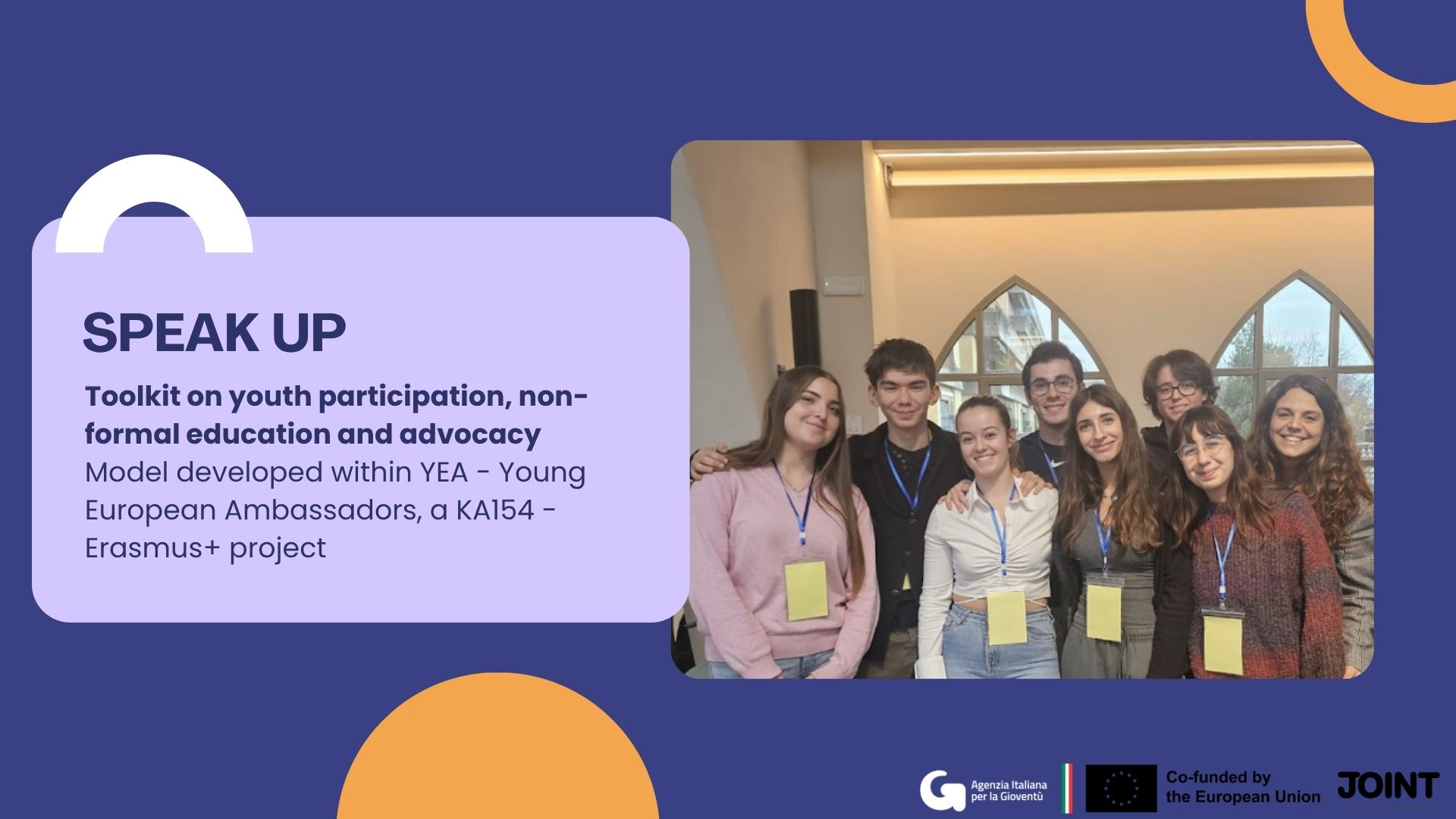
Youth exchanges are powerful experiences. But what happens when young people go home? For many, the energy, the sense of possibility, the new tools for participation — all of it risks staying locked inside a single weekend, a single memory. The YEA project — Young European Ambassadors, a KA154 Erasmus+ project run by Associazione Joint — was built precisely to address this question.
A process, not an event
YEA didn’t start from scratch. It grew out of mobility experiences that a group of young people had already lived in 2024. Those exchanges had opened something — a space for expression, a taste of active participation — but once back in their own communities, there was a real risk that the impact would remain isolated. The project became a bridge: a way to turn what had been experienced into something stable, locally rooted, and progressively more conscious.
Over the course of a year, eleven young people formed a coordinating Core Team and worked together through four interconnected components: monthly meetings for training and group organisation; two residential mobilities at Eutopia in Casaleggio Boiro; local events with NGOs and schools; and a final advocacy action involving the writing and public presentation of a petition.
What made the project distinctive was not any single activity, but the continuity of the process. Each stage prepared the next. The monthly meetings built the group’s capacity to self-organise. The residential weekends deepened relationships and opened the process to other young people beyond the Core Team — former participants, former group leaders — bringing in different perspectives and making the path more inclusive. The local events tested non-formal education in new contexts: in Milan, at Cascina Sant’Ambrogio, young people and representatives of local organisations worked in mixed groups to explore how NFE tools could make local events more participatory. At CAPAC Institute, Core Team members facilitated a session with fourth-year students, discussing how learning happens and what spaces for expression schools actually recognise for young people.
From participation to proposal
The final phase was a deliberate shift: from participation as educational experience to participation as public proposal. The petition — on the role of non-formal education in formal school systems — was built collectively, through listening, needs collection, and a real exercise in synthesis and argumentation. It was then presented at a final event designed as a space for restitution and dialogue, attended by stakeholders, decision-makers, and members of an international inclusion network. The Silent Floor methodology was used to structure the discussion: a tool that collects written contributions on large shared surfaces, allowing people who are less comfortable speaking in plenary to participate fully.
The event surfaced three thematic clusters that youth workers and project designers will recognise immediately: the need for greater public and professional recognition of youth work; the challenge of bringing non-formal education into school systems in ways that don’t dilute its identity; and the importance of peer-to-peer approaches and local anchor points for promoting mobility opportunities to young people who haven’t yet heard of Erasmus+.
What the toolkit offers
The SPEAK UP toolkit — freely available and written in accessible, non-technical language — documents this entire arc. It doesn’t present itself as a replicable model to be copied wholesale, but as a readable account of a process: how a group of young people, accompanied by an experienced organisation, built autonomy gradually, moved from local action to institutional dialogue, and produced a public voice together.
For practitioners, the most transferable elements are probably structural: the combination of a stable coordinating group with periodic residential intensives; the deliberate use of mixed, outward-facing local events to widen the circle beyond the core participants; and the design of the final advocacy step as a genuine culmination rather than a symbolic add-on.
The toolkit is a product of Associazione Joint. For questions about the process or potential collaborations: [email protected].
The SPEAK UP toolkit was developed within the YEA – Young European Ambassadors project, co-funded by the European Union under Erasmus+ KA154. Views expressed are those of the authors and do not necessarily reflect those of the EU or EACEA.