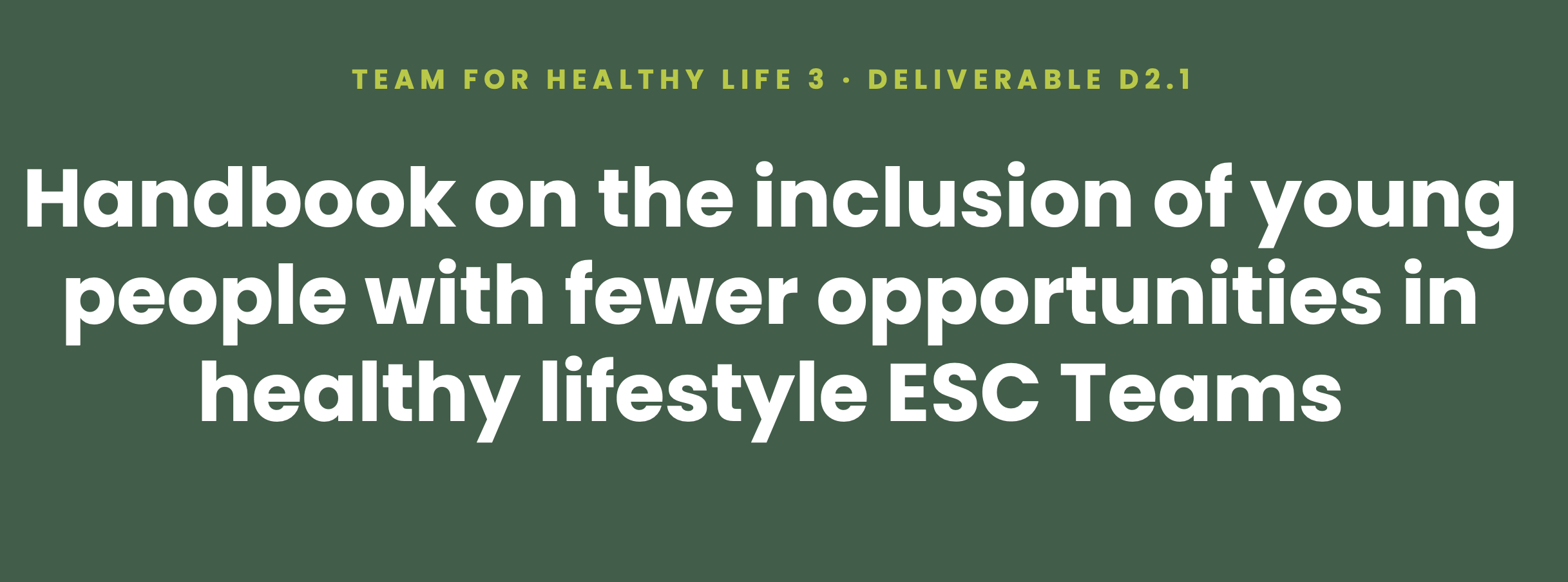
A healthy lifestyle is not only about what we eat or how much we move. It is also about feeling part of a group, being useful and being seen. This is the idea behind the Handbook on the inclusion of young people with fewer opportunities in healthy lifestyle ESC Teams, a new free publication by Associazione Joint APS.
The handbook is a result of Team for Healthy Life 3 (T4HL3), the third edition of a European Solidarity Corps Volunteering Teams project coordinated by Joint. In 2025, T4HL3 brought young people from all over Europe to Italian host organisations for one or two months of volunteering on physical activity, nature, food and mental well-being.
One question, six Teams
The handbook asks one question: how can an ESC Team on healthy lifestyles be designed so that young people with fewer opportunities take part fully, and leave stronger?
The answers come from six Teams hosted by five organisations between March and December 2025. They involved 109 volunteers aged 18 to 31 from 18 countries: 73 of them had fewer opportunities, 18 were fleeing armed conflict and 28 were in-country volunteers living in Italy. Many faced more than one obstacle at the same time, from living in rural areas with few services to low income, isolation, health conditions or a first experience abroad.
Five territories, five ways to live healthy
- Legambiente Lecco – Ostello Parco Monte Barro (Galbiate, Lecco) – the park as a gym: volunteers saved migrating toads, built an ecological area for waste sorting, hiked and climbed.
- Fattoria l’Arca (Belvedere Marittimo, Cosenza) – two two-month Teams on an organic social farm, “from the field to the table”: strawberries, olives, beehives, and workshops with local artisans and associations.
- Cooperativa ONE (Crotone) – a city to discover: food recovery for people in need, work on land confiscated from the mafia, meetings with young migrants and articles written for the local newspaper.
- Cascina EUtopia – P.E.CO. (Casaleggio Boiro, Alessandria) – a farmhouse to build together, with upcycling, paths, a vegetable garden and working hours adapted to the summer heat.
- Farfalle nella Testa (Bordano, Udine) – the “village of butterflies”: care for the Ecomuseum, rafting, tandem paragliding, cycling and a final dinner for 130 villagers.
What made the difference
Every chapter follows the same structure and describes activities step by step, with the voices of volunteers and an honest look at what worked and what didn’t. Across the Teams, one finding stands out: young people with fewer opportunities take part fully when tasks are concrete, groups are balanced, the rhythm is predictable and they have a voice in the rules.
The handbook highlights practices anyone can replicate: letting volunteers choose their task of the day, activities that need no common language, workshops led by the volunteers themselves, dealing with tensions early and structuring peer support from the start. It closes with a practical checklist for before, during and after a Team.
Who is it for?
The handbook is for youth workers, ESC Hosting and Supporting Organisations, mentors and anyone designing activities for young people. Use it as a toolbox, not a recipe. As the authors put it: inclusion is not an extra activity; it is the way every activity is organised.
Download the Handbook on the inclusion of young people with fewer opportunities in healthy lifestyle ESC Teams
Funded by the European Union. Views and opinions expressed are however those of the author(s) only and do not necessarily reflect those of the European Union or the European Education and Culture Executive Agency (EACEA). Neither the European Union nor EACEA can be held responsible for them.